


Health testing is a core responsibility of ethical breeding. At Brinton Goldens, it is not optional or done for appearances. It is a foundational part of our program and a key factor in every breeding decision we make. Our goal is to produce Golden Retrievers who are not only beautiful and well tempered, but physically sound and built for long, healthy lives.
Health testing consists of standardized evaluations used to assess a dog’s genetic health, structure, and overall physical wellbeing before breeding. These tests help identify inherited conditions and potential health risks that could be passed on to future generations. Responsible health testing allows us to make informed breeding decisions, reduce the risk of hereditary disease, and protect both our puppies and the breed as a whole.
We follow the health testing recommendations set by the Golden Retriever Club of America (GRCA) and often go beyond minimum requirements. GRCA guidelines are based on decades of research and breed-specific data and exist to protect the future of the breed by prioritizing health, longevity, and soundness. All of our breeding dogs complete required health clearances before being bred. We believe responsibility to our dogs, our puppies, and future families matters.


HIPS
Evaluation of the structure and alignment of a dog’s hip joints to screen for hip dysplasia. Radiographs are reviewed by board-certified veterinary radiologists through the Orthopedic Foundation for Animals, providing an objective assessment of joint conformation and stability. Passing results help reduce the risk of inherited hip disease and support breeding decisions focused on long-term mobility, comfort, and structural soundness.

OFA HEALTH TESTING
The Orthopedic Foundation for Animals (OFA)
provides standardized evaluations for many inherited and structural conditions. OFA results are publicly accessible, allowing for transparency and accountability.
Our dogs are evaluated through OFA for the following:
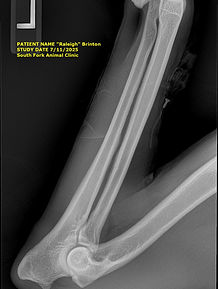


ELBOWS
OFA Elbow Evaluations screen for elbow dysplasia, a painful and often inherited condition that can limit a dog’s comfort and mobility. Radiographs are reviewed by board-certified veterinary radiologists through the Orthopedic Foundation for Animals, assessing joint structure and identifying abnormalities such as fragmentation or arthritic changes. Clear elbow results help reduce the risk of passing on orthopedic disease and support breeding decisions focused on sound movement and long-term joint health.
PATELLA
OFA Patella Evaluations assess the stability of the kneecap to screen for patellar luxation, a condition where the kneecap slips out of place and can affect comfort and gait. This exam evaluates proper alignment and tracking of the patella within the joint. Normal results help reduce the risk of inherited knee issues and support breeding decisions focused on sound movement and long-term structural stability.
EYES
CAER Eye Evaluations screen for inherited and acquired eye conditions that can affect vision and long-term eye health. Exams are performed annually by board-certified veterinary ophthalmologists and recorded through the Orthopedic Foundation for Animals CAER program. Clear results help reduce the risk of passing on hereditary eye disease and support breeding decisions focused on lifelong visual health and quality of life.
DENTITION
Dentition Evaluations assess a dog’s bite, tooth alignment, and overall dental structure to ensure a correct and functional mouth. Proper dentition supports effective chewing, jaw development, and long-term oral health. In breeding programs, dentition evaluations help identify inherited bite faults or missing teeth and support breeding decisions focused on correct structure and functional soundness.

PennHIP TestingHip health matters. A lot. Especially in Golden Retrievers.PennHIP is a specialized diagnostic screening that measures hip joint laxity, or looseness, which is one of the strongest predictors of whether a dog will develop hip dysplasia later in life. Unlike some screening methods, PennHIP doesn’t rely on a subjective pass or fail or a single static image. It provides a numerical score called a Distraction Index (DI) that objectively quantifies how stable or loose a dog’s hips truly are.
One of the biggest advantages of PennHIP is that it can be performed as early as 16 weeks of age and is designed to identify risk before degenerative changes appear. This allows breeders to make informed decisions based on a dog’s actual hip structure and genetic risk, not just how the joint looks at one moment in time.
PennHIP vs. OFA
OFA hip evaluations and PennHIP testing serve different but complementary purposes.
OFA evaluates hip conformation using a single extended-view radiograph and assigns a rating such as Excellent, Good, Fair, or Dysplastic. This assessment focuses on how the hip joint appears at maturity and whether arthritic changes are present. It is a valuable tool, especially for documenting structural soundness and long-term joint health.
PennHIP, on the other hand, measures joint laxity through a series of specialized views that evaluate how much the femoral head can move within the hip socket. This laxity is a key genetic factor in the development of hip dysplasia and cannot be accurately assessed through appearance alone.In simple terms, OFA tells us how the hips look. PennHIP tells us how the hips function under stress.
Why We Do Both
We believe relying on only one method leaves gaps.
A dog can pass OFA with a Good or even Excellent rating and still have higher-than-average joint laxity that increases their risk for hip dysplasia. Likewise, a dog may have tight, stable hips on PennHIP but not present as well on an extended OFA view due to positioning or muscle tension.
By performing both PennHIP and OFA, we gain a more complete, honest picture of each dog’s hip health. This allows us to make breeding decisions based on objective data, structural evaluation, and long-term soundness rather than minimum requirements.
Our goal is not just to meet health testing standards. It’s to exceed them. Doing both PennHIP and OFA reflects our commitment to transparency, responsible breeding, and producing Golden Retrievers who can live long, active, comfortable lives as family companions and service dogs.

CARDIAC
Advanced Cardiac Evaluation with Echocardiogram assesses heart structure and function to screen for congenital and inherited heart disease. This testing is performed by a board-certified veterinary cardiologist using echocardiography to evaluate blood flow, chamber size, valve function, and overall cardiac health. Results are submitted to the Orthopedic Foundation for Animals when applicable. Advanced cardiac testing provides a deeper, more accurate assessment than auscultation alone and supports breeding decisions focused on longevity, endurance, and overall cardiovascular soundness.
Embark Genetic Testing
Genetics matter, whether people want to admit it or not. Embark genetic testing allows us to look far beyond what’s visible on the surface and evaluate the inherited health of our dogs at a molecular level. Through a simple DNA sample, Embark screens for hundreds of known genetic conditions, traits, and risk factors that can impact a dog’s health, longevity, and quality of life.
This testing helps identify whether a dog is clear, a carrier, or at risk for specific inherited diseases. Carriers are not automatically unhealthy dogs, but knowing their status is critical. Responsible breeding isn’t about eliminating dogs. It’s about understanding genetics well enough to make smart, intentional pairings that reduce risk and protect future generations.
What Embark Tells Us That Physical Exams Cannot
Even the healthiest-appearing dog can carry recessive genetic conditions with no outward signs. These issues can remain hidden for generations until the wrong pairing brings them to the surface.
Embark allows us to:
-
Screen for breed-relevant genetic diseases
-
Identify carrier status before breeding
-
Avoid producing affected puppies through informed pairings
-
Preserve genetic diversity without gambling with puppy health
-
Make transparent, data-driven decisions
In other words, Embark lets us see what eyes, x-rays, and physical exams simply cannot.
Why Embark Is Not Optional for Us
We do not believe in guessing when science is available. Embark testing gives us clarity and accountability. It allows us to openly share results, stand behind our breeding dogs, and make decisions rooted in evidence rather than assumptions or trends. This is especially important in Golden Retrievers, where certain inherited conditions can significantly impact quality of life if overlooked.
Genetic testing also protects families. When you bring home a puppy, you deserve to know that care and forethought went into every generation behind them.
Embark Alongside Other Health Testing
Embark does not replace orthopedic, cardiac, eye, or structural health testing. Genetics and physical health are two different pieces of the same puzzle. A dog can be genetically clear and still develop orthopedic issues. A dog can be structurally sound and still carry hidden genetic risks. We use Embark alongside PennHIP, OFA, cardiac evaluations, eye exams, and temperament assessment to build the most complete health picture possible.
Health testing isn’t about checking boxes. It’s about stacking the odds in favor of healthier dogs and better futures.
That’s why Embark genetic testing is a non-negotiable part of our program.